Spread the world

Hubert-François BOURGUIGNON d’ANVILLE dit GRAVELOT (1699-1773)

Council of the Order of the Holy Spirit held

Demande d'informations

Acquired by the Musée de la Légion d'Honneur
Red chalk, pen and wash on paper
Signed lower centre H.Gravelot inven.
10,5 x 13,5 cm
Circa 1760

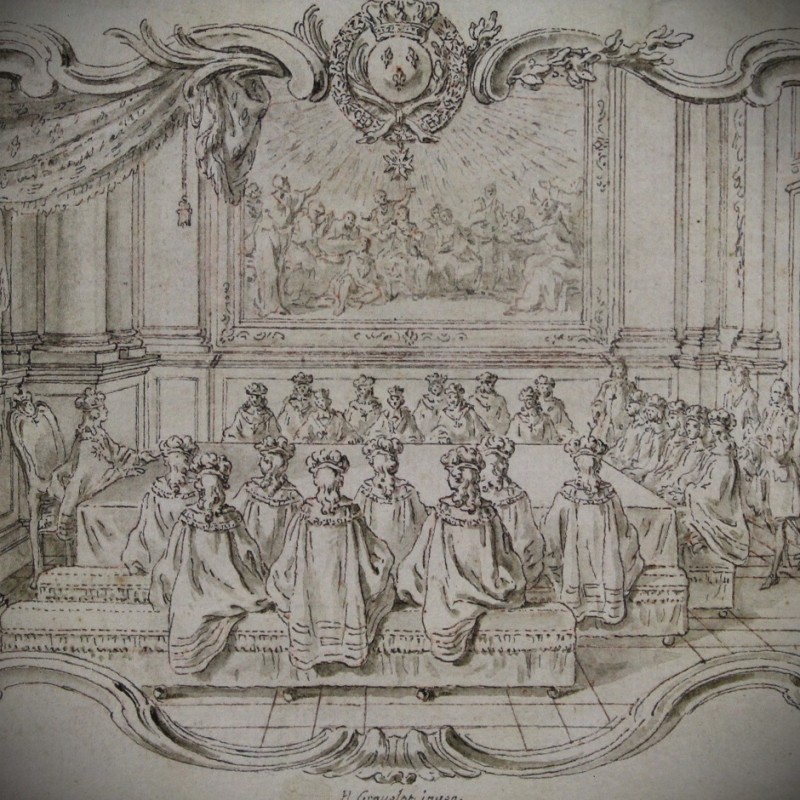
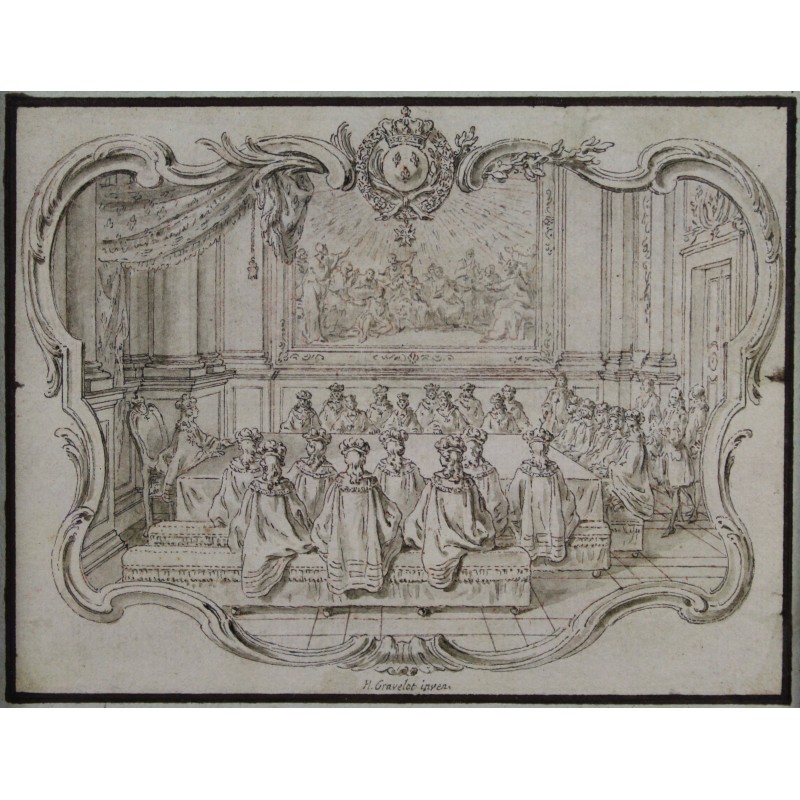
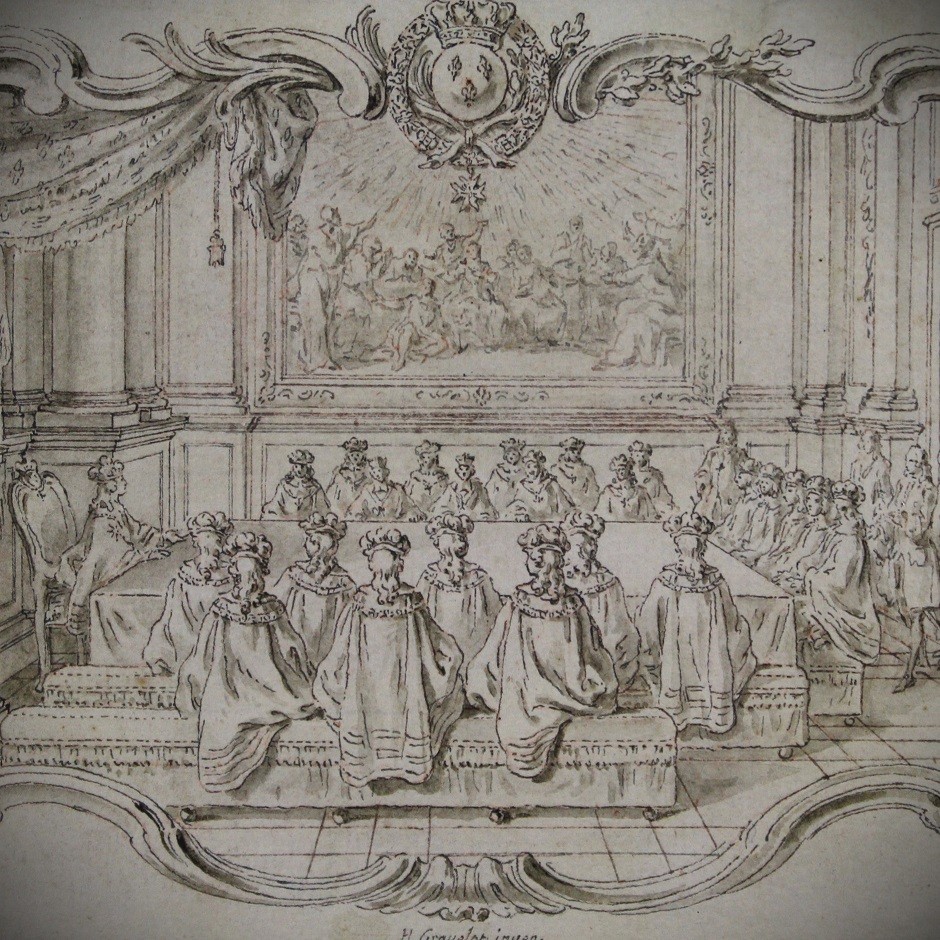
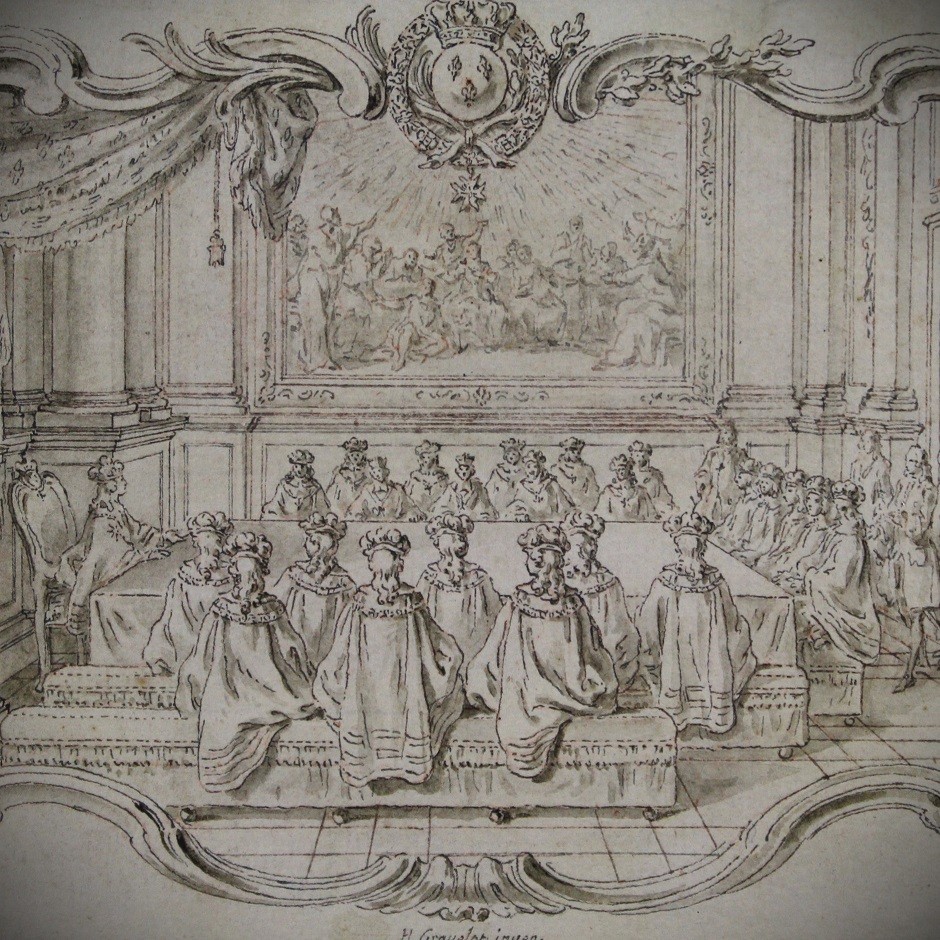
Hubert-François Gravelot drew this Council of the Order of the Holy Spirit held by Louis XV at the Palace of Versailles around 1760.

This drawing was preparatory to one of the engravings illustrating Germain-François Poullain de Saint-Foix’s work publi- shed in 1760, Catalogue des chevaliers, commandeurs et officiers de l’Ordre du Saint-Esprit, avec leurs noms et qualités, depuis l’institution jusqu’à présent (Catalogue of Knights, Commanders, and Officers of the Order of the Holy Spirit, with their names and titles, from its institution to the present (4) ).


Founded on December 31, 1578, by Henry III, the Order of the Holy Spirit remained the most prestigious order of knighthood in the French monarchy for two and a half centuries. Louis XV was the fifth “sovereign grand master” of the Order from 1715 to 1774. The Council depicted in this drawing is the formal plenary meeting that brought together the hundred knights chosen from among the highest nobility, the eight commanders, clergymen, and the four commander-officers who made up the Order around the king to administer it or participate in its solemn ceremonies.

Gravelot is recognized today as one of the best illustrators and cartoonists of the 18th century. He contributed to some of the most beautiful illustrated books of his time. Furthermore, by settling in London between 1732 and 1745, he imported the “French taste” and became one of the promoters of the Rococo style across the Channel, influencing not only painting but also the decorative arts. A student of Jean Restout and François Boucher, he was the teacher of Thomas Gainsborough and thus influenced the evo- lution of the English school of painting. His name may have been eclipsed for a time by other artists of this prolific century, but his talent was rediscovered and rehabilitated in the 19th century, notably thanks to the work of Emmanuel Bocher5 and the Goncourt brothers, who praised his work in their writings on 18th-century art. Preparatory drawings such as this one and thousands of en- gravings can be found in most international institutional collections.

When he produced this drawing, Gravelot was at the height of his career. Based in Paris, he had become a leading artist with a busy schedule. He simultaneously illustrated major literary works, official royal documents, and scientific works. He worked on several major works that definitively confirmed his reputation, including several hundred drawings for the engravings of the De- cameron between 1757 and 1761. Describing himself in 1764 as “a draftsman by taste, an engraver by necessity6 ” he no longer needed to engrave himself at this point in his life and could entrust his drawings to engravers such as Noël Le Mire and Augustin de Saint-Aubin, while supervising their work. He imposed a refined aesthetic that made him a master of illustration and which was best displayed in contemporary subjects, as in this drawing.

1. Michèle Hébert,Edmond Pognon, Yves Bruand, Inventaire du fonds français, graveurs du XVIIIe siècle. Tome X, Gaugain- Gravelot, Paris, 1968, p 551, n° 1075-1103.

2. Emmanuel Bocher, Catalogue raisonné de l’œuvre de Jean-Michel Moreau le Jeune, Paris, 1882.

3. Michèle Hébert, Edmond Pognon, Yves Bruand, Inventaire du fonds français, graveurs du XVIIIe siècle. Tome X, Gaugain- Gravelot, Paris, 1968, p 464

Demande d'informations à propos de Hubert-François BOURGUIGNON d’ANVILLE dit GRAVELOT (1699-1773) Council of the Order of the Holy Spirit held


More info

This drawing was preparatory to one of the engravings illustrating Germain-François Poullain de Saint-Foix’s work publi- shed in 1760, Catalogue des chevaliers, commandeurs et officiers de l’Ordre du Saint-Esprit, avec leurs noms et qualités, depuis l’institution jusqu’à présent (Catalogue of Knights, Commanders, and Officers of the Order of the Holy Spirit, with their names and titles, from its institution to the present (4) ).


Founded on December 31, 1578, by Henry III, the Order of the Holy Spirit remained the most prestigious order of knighthood in the French monarchy for two and a half centuries. Louis XV was the fifth “sovereign grand master” of the Order from 1715 to 1774. The Council depicted in this drawing is the formal plenary meeting that brought together the hundred knights chosen from among the highest nobility, the eight commanders, clergymen, and the four commander-officers who made up the Order around the king to administer it or participate in its solemn ceremonies.

Gravelot is recognized today as one of the best illustrators and cartoonists of the 18th century. He contributed to some of the most beautiful illustrated books of his time. Furthermore, by settling in London between 1732 and 1745, he imported the “French taste” and became one of the promoters of the Rococo style across the Channel, influencing not only painting but also the decorative arts. A student of Jean Restout and François Boucher, he was the teacher of Thomas Gainsborough and thus influenced the evo- lution of the English school of painting. His name may have been eclipsed for a time by other artists of this prolific century, but his talent was rediscovered and rehabilitated in the 19th century, notably thanks to the work of Emmanuel Bocher5 and the Goncourt brothers, who praised his work in their writings on 18th-century art. Preparatory drawings such as this one and thousands of en- gravings can be found in most international institutional collections.

When he produced this drawing, Gravelot was at the height of his career. Based in Paris, he had become a leading artist with a busy schedule. He simultaneously illustrated major literary works, official royal documents, and scientific works. He worked on several major works that definitively confirmed his reputation, including several hundred drawings for the engravings of the De- cameron between 1757 and 1761. Describing himself in 1764 as “a draftsman by taste, an engraver by necessity6 ” he no longer needed to engrave himself at this point in his life and could entrust his drawings to engravers such as Noël Le Mire and Augustin de Saint-Aubin, while supervising their work. He imposed a refined aesthetic that made him a master of illustration and which was best displayed in contemporary subjects, as in this drawing.

1. Michèle Hébert,Edmond Pognon, Yves Bruand, Inventaire du fonds français, graveurs du XVIIIe siècle. Tome X, Gaugain- Gravelot, Paris, 1968, p 551, n° 1075-1103.

2. Emmanuel Bocher, Catalogue raisonné de l’œuvre de Jean-Michel Moreau le Jeune, Paris, 1882.

3. Michèle Hébert, Edmond Pognon, Yves Bruand, Inventaire du fonds français, graveurs du XVIIIe siècle. Tome X, Gaugain- Gravelot, Paris, 1968, p 464

Avis

Aucun avis n'a été publié pour le moment.

Donnez votre avis

Hubert-François BOURGUIGNON d’ANVILLE dit GRAVELOT (1699-1773)

Hubert-François BOURGUIGNON d’ANVILLE dit GRAVELOT (1699-1773)

Hubert-François Gravelot drew this Council of the Order of the Holy Spirit held by Louis XV at the Palace of Versailles around 1760.