Spread the world

Jean-Michel Moreau (Paris, 1741-1814)

"Les Adieux"

Demande d'informations

Brown ink and wash, gouache highlights
20 x 15,5 cm

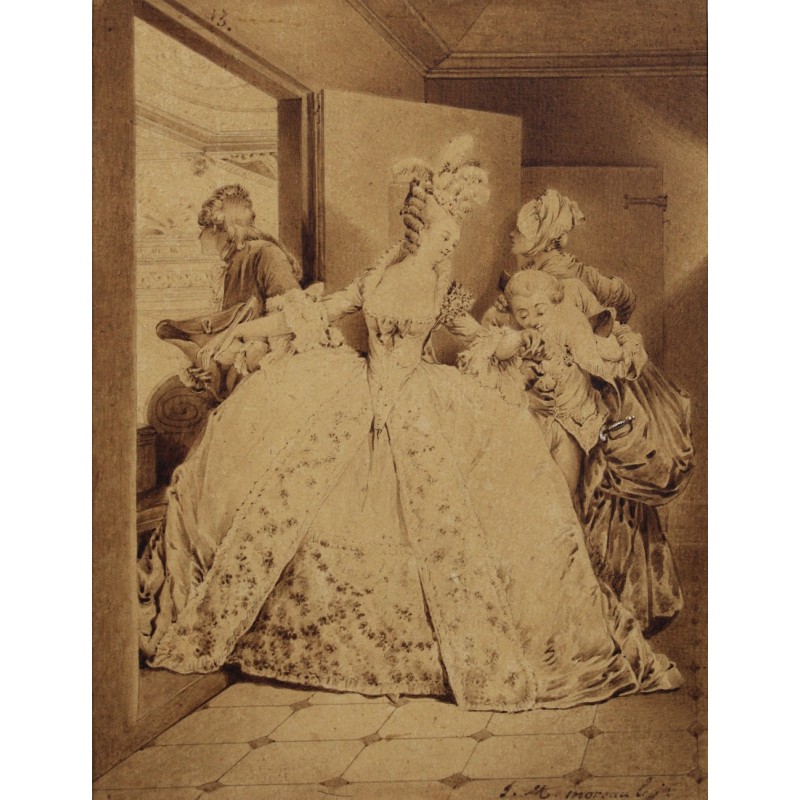
Les Adieux is a charming romantic scene, a genre in which Jean-Michel Moreau, known as Moreau the Younger, specialized.

This drawing was engraved by Robert de Launay the Younger in 1777. The engraving is part of a series entitledEstampes pour servir à l'histoire des mœurs et du costume des François dans le dix-huitième siècle (Prints illustrating the history of French customs and costumes in the eighteenth century), later known as Monument du costume (Monument to Costume). The preliminary discourse to this series states: “We have endeavored to render famous figures (...) with greater accuracy and in accordance with nature, along with the clothing and furnishings in vogue during the years 1775 and 17761. This drawing is both a perfect example of Moreau Le Jeune's talent and a valuable testimony to the fashion and customs of high society in the second half of the 18th century.

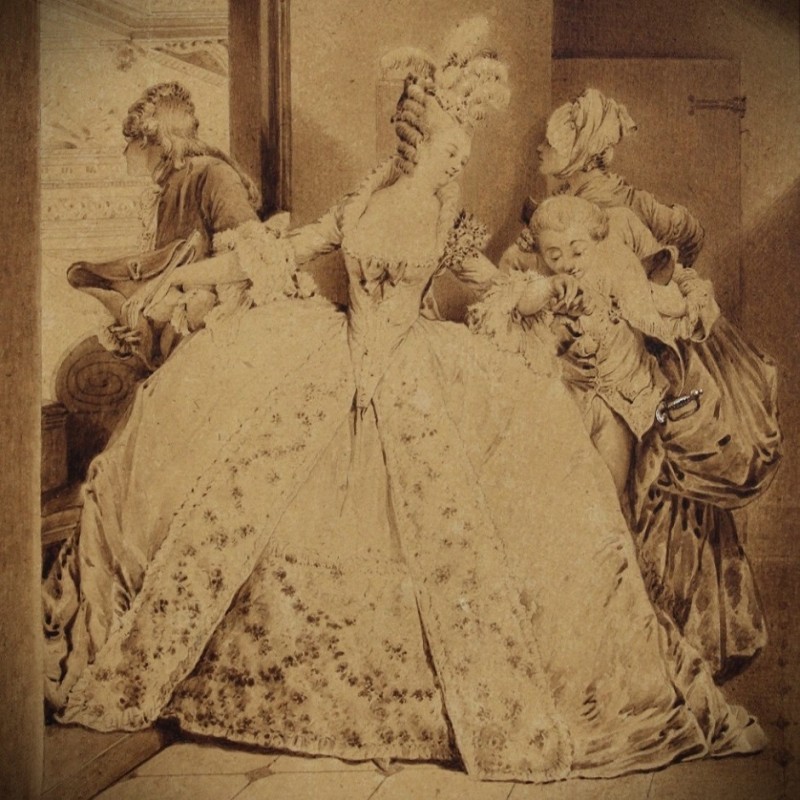
The engraving illustrated a specific episode from a work of fiction, the life of Céphise, a virtuous but neglected young wife. The composition of this charming scene at the door of an opera box is centered on the figure of the young woman dressed in an imposing and elegant hoop skirt. The engraving was accompanied by the caption:

“Céphise vainly resists the theft of love;

He steals a charming kiss.

For Céphise it is a small thing,

And it is a great thing for her lover.”

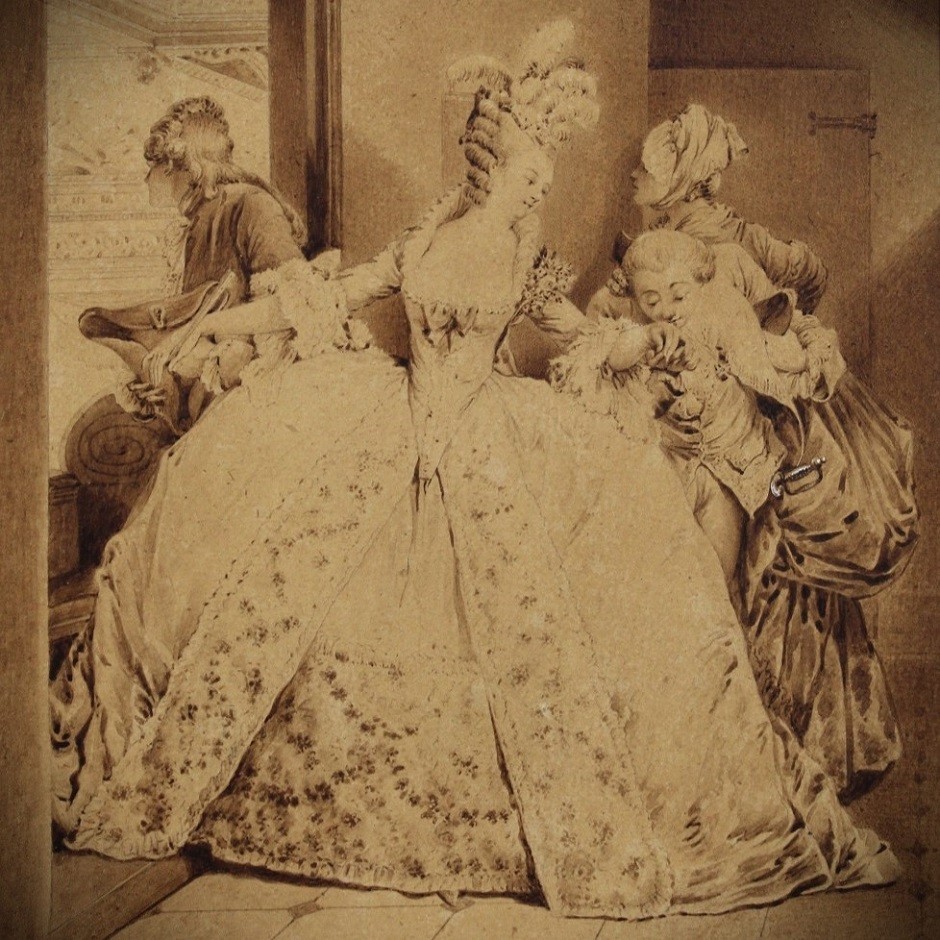
Moreau's skillful composition shows this woman physically and metaphorically torn between her husband, who is holding her hand to encourage her to enter the box, and her young lover, who is leaning over to kiss her other hand. She looks at her admirer, unlike her husband and the usher, who are turning toward the auditorium. The series of engravings was republished in 1789 with a new text by Restif de la Bretonne, who changed the characters and the story, but what matters lies elsewhere: the clever play of light and shadow and the choice of poses serve above all to highlight the young woman's spectacular dress. The engraving was described by the Goncourt brothers as a “coquettish and magnificent plate, filled with the splendor of this woman and the opulent fullness of her dress.”2

When he produced this drawing, Moreau was perfectly integrated into Parisian high society. He was no longer the young artist of the 1760s who engraved technical plates for the Encyclopédie in order to survive.

He held an official position at court, succeeding Charles-Nicolas Cochin in 1770 as Dessinateur des Menus Plaisirs du roi (Designer of the King's Menus Plaisirs). He had the prestigious task of immortalizing the court's celebrations and entertainments, which gave him a thorough knowledge of the fashion and customs of the high society of his time. It was thanks to this position that the financier Jean-Henri Eberts called on him to replace the Swiss designer Freudeberg and produce the Second Series of Prints for the History of Fashion and Costume, which included Les Adieux. A few years later, in 1781, Moreau was appointed designer and engraver to the King's Cabinet and was accepted and then admitted to the Royal Academy of Painting and Sculpture.

Moreau profited greatly from his art and was able to produce several versions or variations of the same drawing. Although he held an official position from 1770 onwards, Moreau's income was mainly based on luxury illustration and the publication of series of engravings. His drawings, which were generally very accomplished, were designed to serve as models for engravers, but they were also considered works of art in their own right and were highly sought after. It was common for Moreau to produce several versions of the same composition. These could take the form of very detailed studies, variations, or repetitions of a successful subject. For example, there are two known versions of Lever, one held at the Petit Palais in Paris3 and another formerly held in the Edmond Rothschild collection4, and La Petite Loge, of which a brown wash drawing is held at Waddesdon Manor5 and a beautiful, highly detailed study in three pencils for the young woman is held at the National Gallery in Washington6. There are also several versions of this drawing, one of which is kept at Waddesdon Manor7, part of the Rothschild Foundation, and another in the Horvitz collection. A sketch on the back of the Waddesdon drawing reveals that Moreau the Younger had initially planned to include more characters before focusing on this more intimate and compact scene.

1. M.J.F. Mahérault, L’œuvre de Moreau Le Jeune, Paris, 1880, p. 386, n°358-22.

2. Edmond et Jules de Goncourt, L'art du dix-huitième siècle, Paris, 1874, II, p . 176-177.

3. inv. PPD2065

4. Louis Antoine Prat, Le dessin au XVIIIe siècle, Paris, 2017, p. 457

5. Inv. 203.2003

6. Inv. 1942.9.1202

7. Inv. 200.2003

Demande d'informations à propos de Jean-Michel Moreau (Paris, 1741-1814) "Les Adieux"


More info

This drawing was engraved by Robert de Launay the Younger in 1777. The engraving is part of a series entitledEstampes pour servir à l'histoire des mœurs et du costume des François dans le dix-huitième siècle (Prints illustrating the history of French customs and costumes in the eighteenth century), later known as Monument du costume (Monument to Costume). The preliminary discourse to this series states: “We have endeavored to render famous figures (...) with greater accuracy and in accordance with nature, along with the clothing and furnishings in vogue during the years 1775 and 17761. This drawing is both a perfect example of Moreau Le Jeune's talent and a valuable testimony to the fashion and customs of high society in the second half of the 18th century.

The engraving illustrated a specific episode from a work of fiction, the life of Céphise, a virtuous but neglected young wife. The composition of this charming scene at the door of an opera box is centered on the figure of the young woman dressed in an imposing and elegant hoop skirt. The engraving was accompanied by the caption:

“Céphise vainly resists the theft of love;

He steals a charming kiss.

For Céphise it is a small thing,

And it is a great thing for her lover.”

Moreau's skillful composition shows this woman physically and metaphorically torn between her husband, who is holding her hand to encourage her to enter the box, and her young lover, who is leaning over to kiss her other hand. She looks at her admirer, unlike her husband and the usher, who are turning toward the auditorium. The series of engravings was republished in 1789 with a new text by Restif de la Bretonne, who changed the characters and the story, but what matters lies elsewhere: the clever play of light and shadow and the choice of poses serve above all to highlight the young woman's spectacular dress. The engraving was described by the Goncourt brothers as a “coquettish and magnificent plate, filled with the splendor of this woman and the opulent fullness of her dress.”2

When he produced this drawing, Moreau was perfectly integrated into Parisian high society. He was no longer the young artist of the 1760s who engraved technical plates for the Encyclopédie in order to survive.

He held an official position at court, succeeding Charles-Nicolas Cochin in 1770 as Dessinateur des Menus Plaisirs du roi (Designer of the King's Menus Plaisirs). He had the prestigious task of immortalizing the court's celebrations and entertainments, which gave him a thorough knowledge of the fashion and customs of the high society of his time. It was thanks to this position that the financier Jean-Henri Eberts called on him to replace the Swiss designer Freudeberg and produce the Second Series of Prints for the History of Fashion and Costume, which included Les Adieux. A few years later, in 1781, Moreau was appointed designer and engraver to the King's Cabinet and was accepted and then admitted to the Royal Academy of Painting and Sculpture.

Moreau profited greatly from his art and was able to produce several versions or variations of the same drawing. Although he held an official position from 1770 onwards, Moreau's income was mainly based on luxury illustration and the publication of series of engravings. His drawings, which were generally very accomplished, were designed to serve as models for engravers, but they were also considered works of art in their own right and were highly sought after. It was common for Moreau to produce several versions of the same composition. These could take the form of very detailed studies, variations, or repetitions of a successful subject. For example, there are two known versions of Lever, one held at the Petit Palais in Paris3 and another formerly held in the Edmond Rothschild collection4, and La Petite Loge, of which a brown wash drawing is held at Waddesdon Manor5 and a beautiful, highly detailed study in three pencils for the young woman is held at the National Gallery in Washington6. There are also several versions of this drawing, one of which is kept at Waddesdon Manor7, part of the Rothschild Foundation, and another in the Horvitz collection. A sketch on the back of the Waddesdon drawing reveals that Moreau the Younger had initially planned to include more characters before focusing on this more intimate and compact scene.

1. M.J.F. Mahérault, L’œuvre de Moreau Le Jeune, Paris, 1880, p. 386, n°358-22.

2. Edmond et Jules de Goncourt, L'art du dix-huitième siècle, Paris, 1874, II, p . 176-177.

3. inv. PPD2065

4. Louis Antoine Prat, Le dessin au XVIIIe siècle, Paris, 2017, p. 457

5. Inv. 203.2003

6. Inv. 1942.9.1202

7. Inv. 200.2003

Avis

Aucun avis n'a été publié pour le moment.

Donnez votre avis

Jean-Michel Moreau (Paris, 1741-1814)

Jean-Michel Moreau (Paris, 1741-1814)

Les Adieux is a charming romantic scene, a genre in which Jean-Michel Moreau, known as Moreau the Younger, specialized.