
 View larger
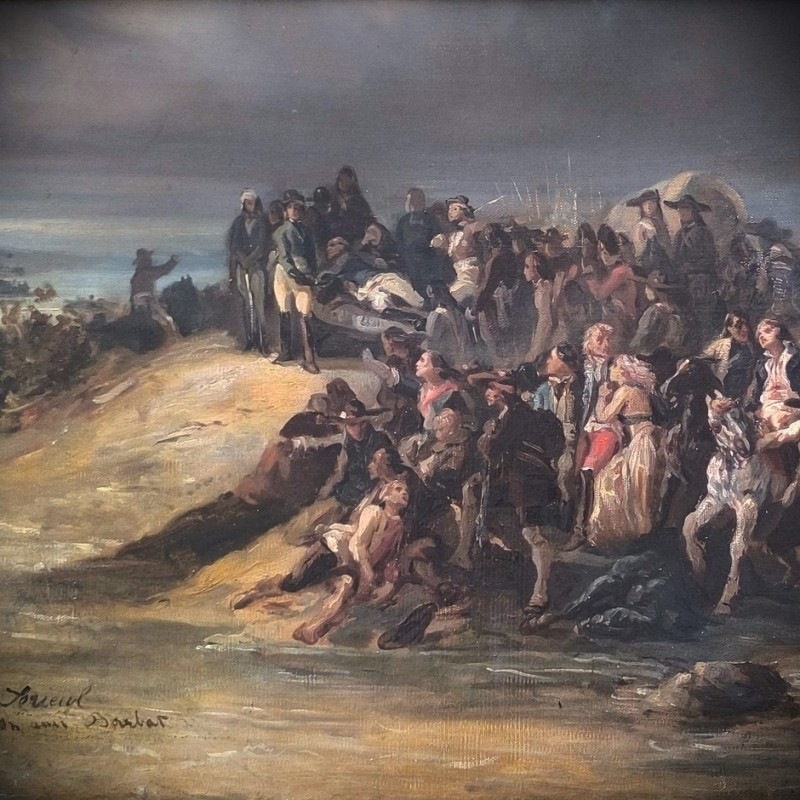
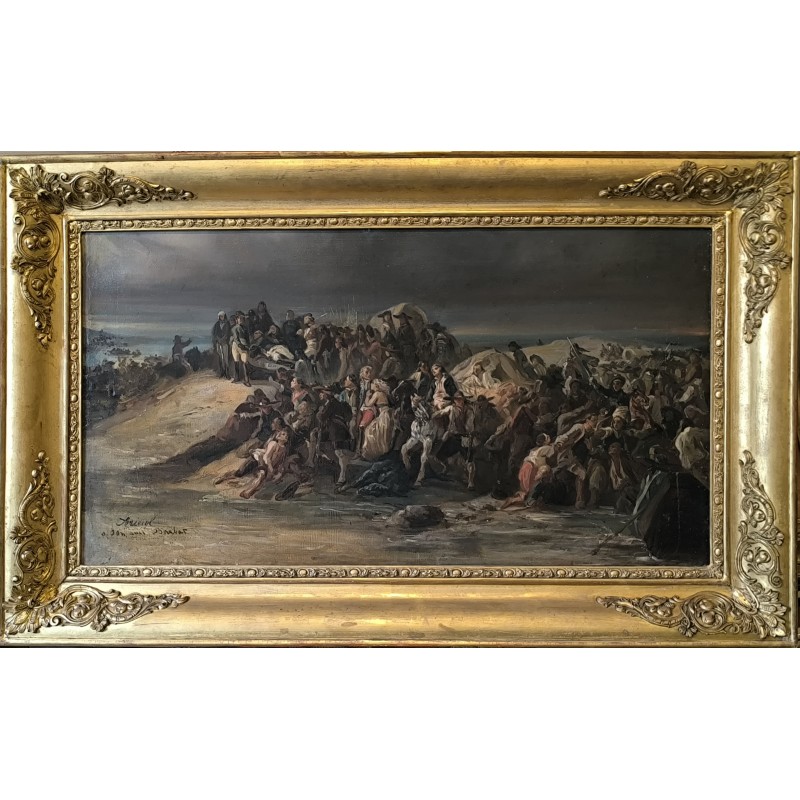
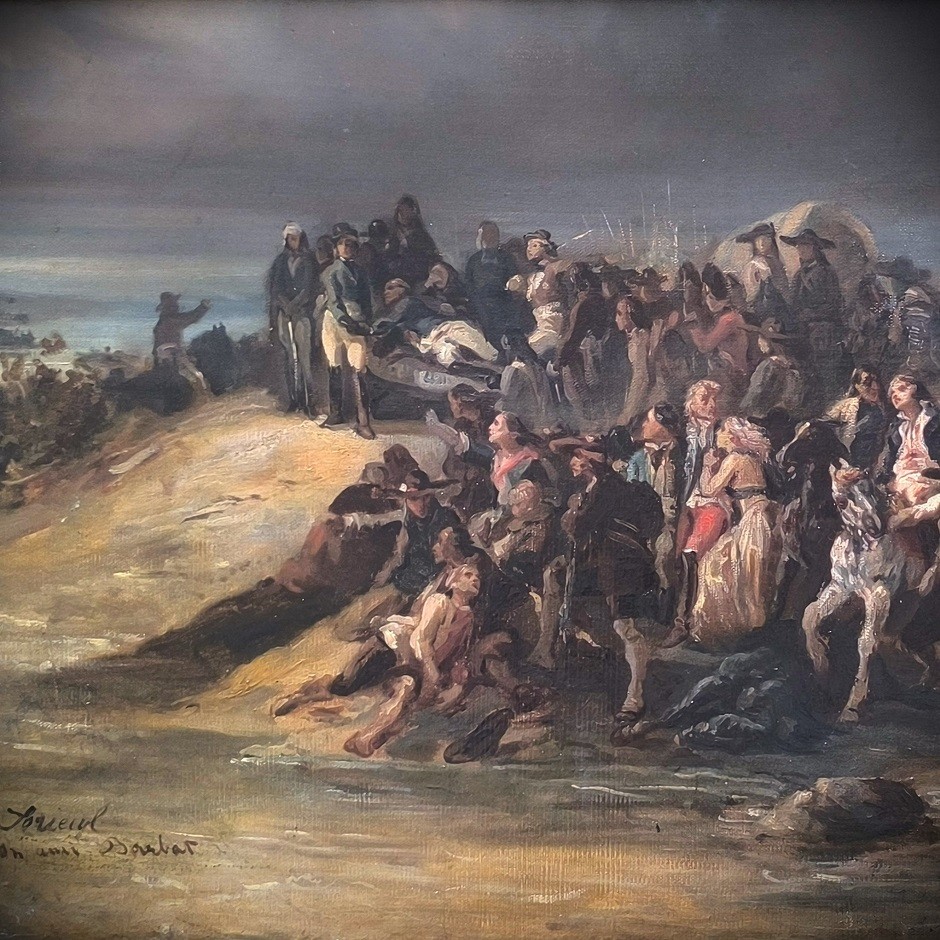
Jean SORIEUL (1823-1871)
Demande d'informations
| Oil on canvas |
| Signed and autographed in the lower left corner |
| 46 x 65 cm |
| Circa 1848 |
More info
Jean Sorieul, a native of Rouen, had been fascinated by the military from an early age. At school, he preferred to doodle battle scenes rather than listen to his teachers.
In 1843, after several years at the Rouen School of Drawing, he joined Hippolyte Bellangé's studio, where he remained for two years before moving on to Léon Cogniet's studio.
His vocation as a battle painter led him to spend time at the Camp de Bretagne to immerse himself in the life of a soldier and make sketches. It was undoubtedly at this time that his passion for the Wars of the Vendée was born, a subject he would depict many times, notably in “La Bataille du Mans” (The Battle of Le Mans), presented at the 1850 Salon and now in the Musée du Mans, and “Le Combat de Quiberon” (The Battle of Quiberon), exhibited at the 1852 Salon and now in the Musée de Cholet. Another work, signed and dated 1854, appeared at Drouot in December 2017. The scene, set in the middle of the bocage, shows the Vendée army on one side and the Republican army on the other, in the middle of which a peasant woman seems to be betraying her side.
In Hédouin's book on the life of Jean Sorieul, published in 1882, we read: "In 1848, he exhibited Le Passage de la Loire par l'Armée Vendéenne à Saint-Florent [...]. The painting must have found a buyer, as it did not appear at the thirteenth exhibition in Rouen in 1849, and the artist would certainly have sent it if he had still had it in his possession."
In the “Explanation of the Works of Painting by Living Artists, exhibited at the National Museum of the Louvre on March 15, 1848,” we can read about the finished work “Passage of the Loire by the Vendée Army, at Saint-Florent;” "The fires of the villages rose on the horizon in the darkness of a stormy sky, lightning and cannon fire thundered in the distance, and this terrified, confused multitude, weeping, searching for their loved ones and friends, impatient to put the river between themselves and their enemies, prevented any order in the army; the wounded and the children were screaming horribly; the Breton peasants encouraged their brothers on the other side and brought frail boats to this crowd, which rushed forward at once and stretched out their tearful hands. La Rochejacquelien, distraught, ran, threatened and wanted to be killed on the riverbank: Lescure, carried on a mattress, asked that they be allowed to be massacred with him! General, cried Stofflet; let us take a hundred brave men and go to die at Châtillon. "
Unfortunately, the whereabouts of this painting have been unknown since 1848, but we know of a second version, signed and dated 1849, which is in private hands. Although it is more elongated in format, the composition is the same with a few minor differences here and there, particularly in the placement of the figures.
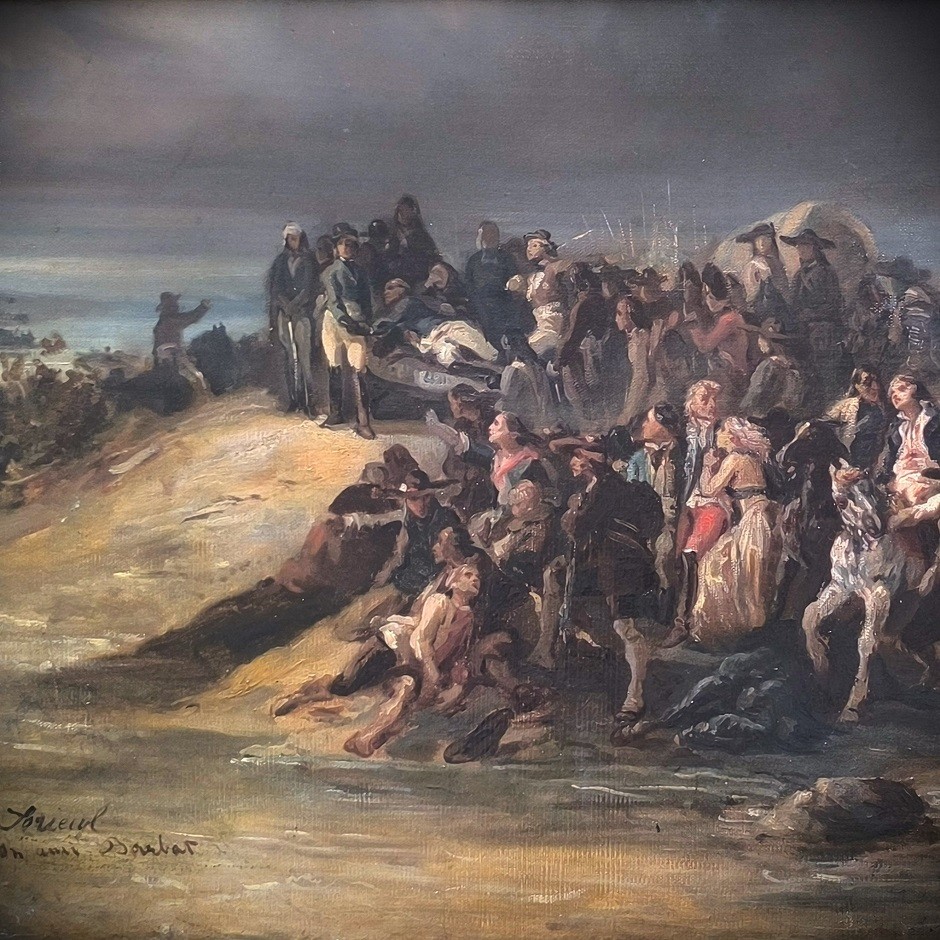
A copy of our study with the same dimensions appeared on the market in 2012. It bore a signature in the lower left corner: “César Mad. 11 1905,” and on the back a note: “based on a study by Béranger.” Surely they meant Bellanger?
“The Crossing of the Loire by the Vendée Army at Saint Florent”
After their defeat at Cholet, the Vendée army began their retreat. To escape the Republican army, they decided to regroup on the other side of the Loire, which was only possible at Saint-Florent. The crossing took place over two days, October 17 and 18, 1793, using all the boats they could find. It is said that 80,000 men, women, and children took part. When the Republican vanguard entered Saint-Florent on the night of October 19, all the Vendéens had disappeared.
It was during this episode that Bonchamp uttered his famous words: “Thanks to the prisoners!”
Avis
Aucun avis n'a été publié pour le moment.