
 View larger
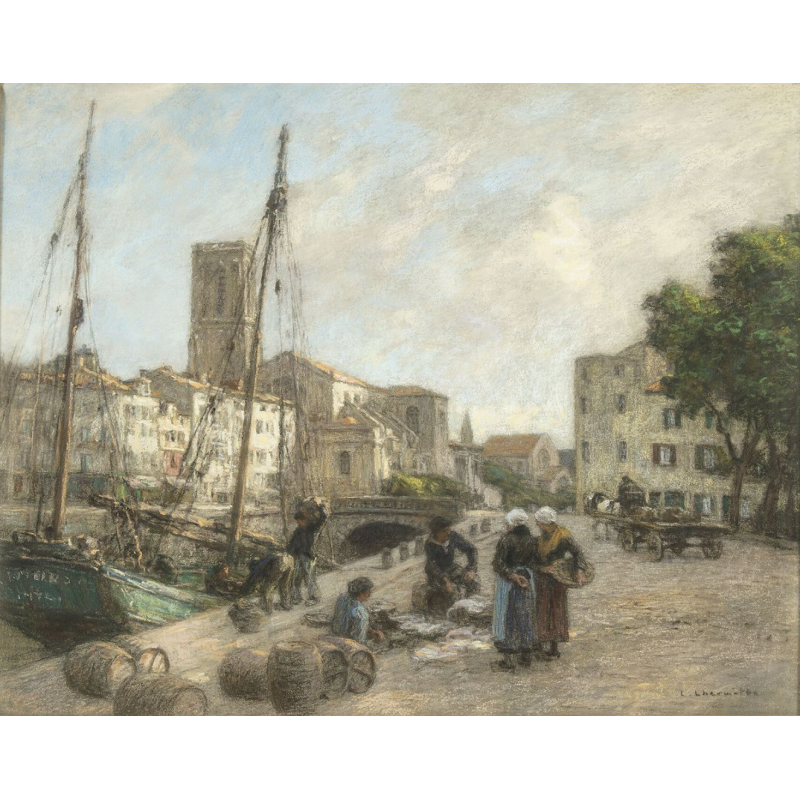
Léon Lhermitte (1844-1925)
Demande d'informations
| Pastel on paper |
| 36 x 45 cm |
| Provenance: |
| Boussod Valadon & Cie, no. 21960; Bernheim |
| Exposition: |
| 1913, Galerie Boussod Valadon & Cie, Lhermitte Reproduced on page 11 of the catalogue |
| Littérature: |
| 1913, Galerie Boussod Valadon & Cie, Lhermitte Reproduit page 11 du catalogue |
| Littérature: |
| Le Pelley Fonteny, 584 |
More info
Léon Lhermitte (1844–1925) was a French painter and engraver renowned for his scenes of peasant life. Born in Mont-Saint-Père, Picardy, he enrolled at the École Impériale de Dessin in Paris, where he honed his skills under the guidance of Horace Lecoq de Boisbaudran.
Lhermitte stood out for his striking realism and attention to detail, influenced by Jean-François Millet and Gustave Courbet. His works, often done in pastel or oil, illustrate the hard work of peasants with humanity and precision. Among his most famous paintings, La Paye des moissonneurs (The Harvesters' Pay, 1882) reflects his social commitment and attachment to the rural world.
His talent was recognised beyond France's borders, and he exhibited regularly at the Paris Salon. Awarded numerous distinctions, including the Legion of Honour, he also inspired the Impressionist painters with his mastery of light and composition. Van Gogh himself admired his work.
In 1895, Lhermitte produced Les Halles, one of his masterpieces, in which he captured the hustle and bustle of the famous Parisian market with remarkable precision. This painting illustrates the daily life of traders and customers in what was then known as the ‘belly of Paris’, in reference to Émile Zola's novel.
Lhermitte displays all his talent as a naturalist painter, capturing the moving crowd, the expressions of the merchants and the diversity of the products on display. The dynamic and detailed composition conveys the hustle and bustle of the place, bathed in natural light that enhances the realism of the scene.
Through Les Halles, he bears witness not only to the urban life of his time, but also to his constant interest in scenes of work and the daily life of the people. His work, at the crossroads of naturalism and social realism, remains a reference for understanding late 19th-century society and the evolution of French painting.
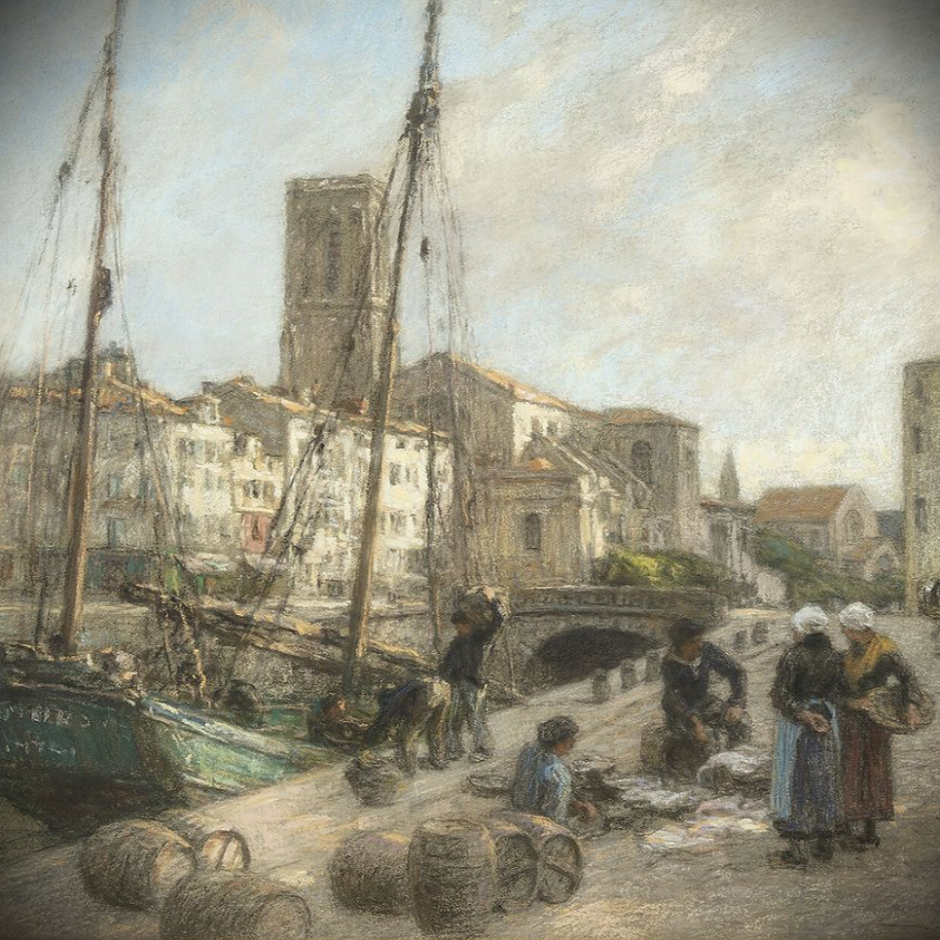
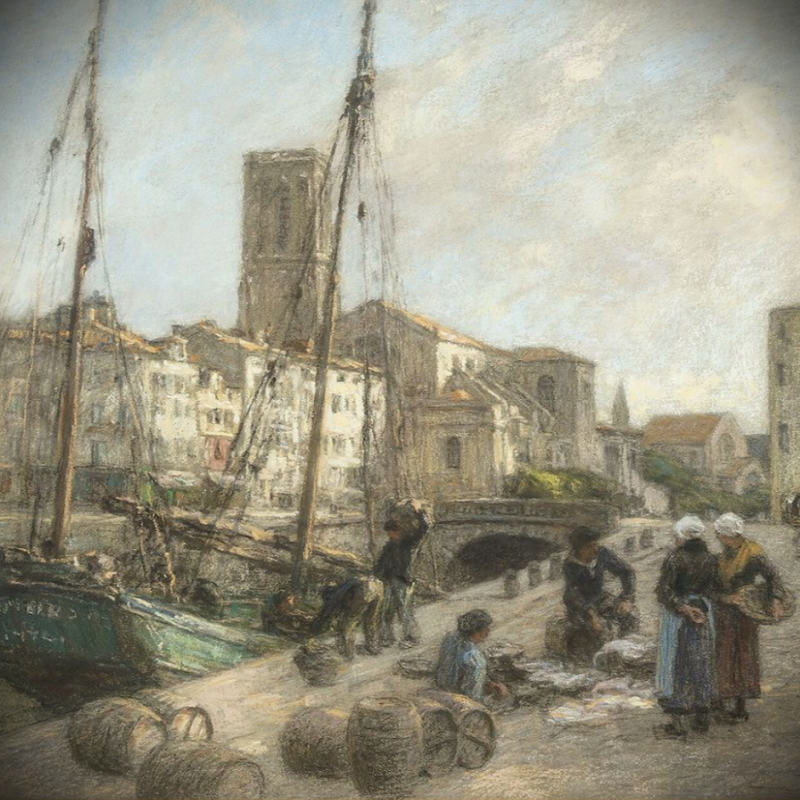
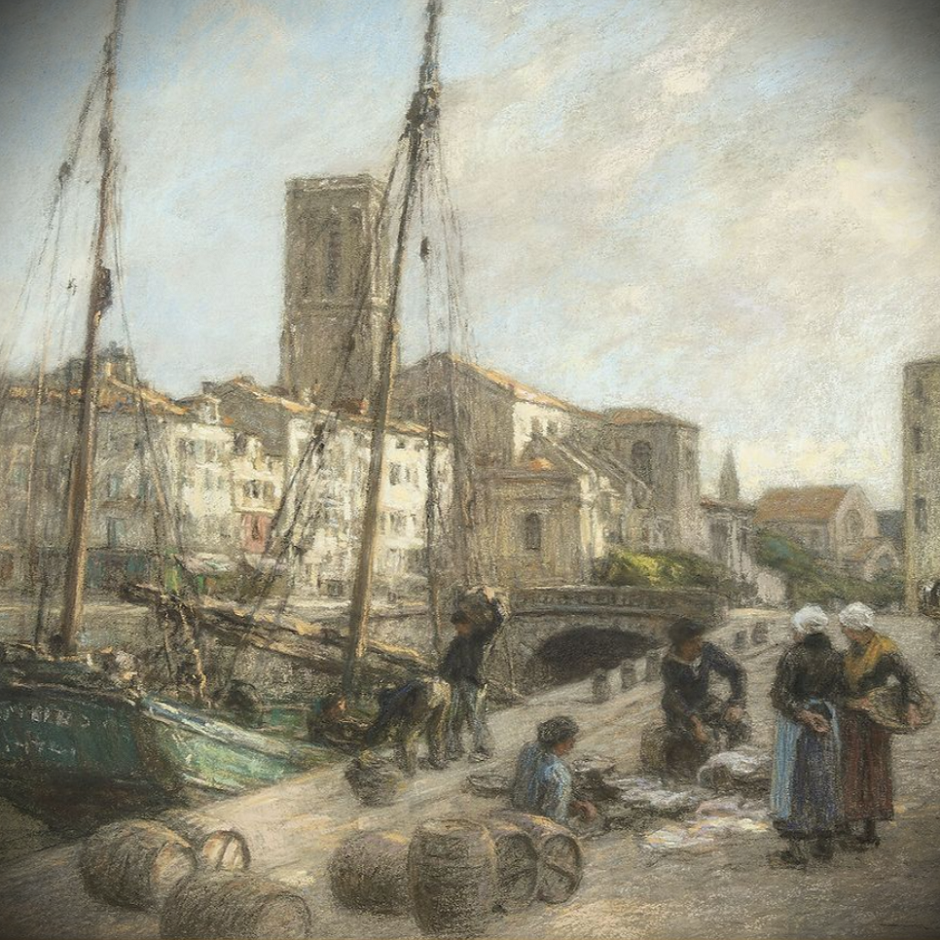
In this work, Léon Lhermitte realistically captures a lively port scene in La Rochelle, illustrating the daily life of fishermen and fishmongers on the quayside.
The composition is organised into several planes: in the foreground, figures bustle around baskets and nets, while a bridge visually connects the activity of the port to the city in the background, where stone buildings and an imposing church stand. The masts of the boats introduce a verticality that contrasts with the horizontality of the quay, reinforcing the balance of the scene.
True to his naturalistic approach, Lhermitte favours a palette of earthy and pastel tones, bathing the scene in soft light that accentuates the realism of the moment. Without seeking to idealise, he accurately captures the hustle and bustle of port life and the harsh reality of daily labour, thus offering a valuable testimony to coastal life at the end of the 19th century.
Avis
Aucun avis n'a été publié pour le moment.